01 Overview
Battery cell discharge curves V(t) are easy to collect and contain rich
information about what's actually limiting the cell — but extracting that information
normally requires expensive parameter fitting against full physics-based models (P2D,
Newman). This project shows that a properly-constrained PINN can do the inversion in one
shot, producing physically meaningful parameters and a mechanism label per cycle.
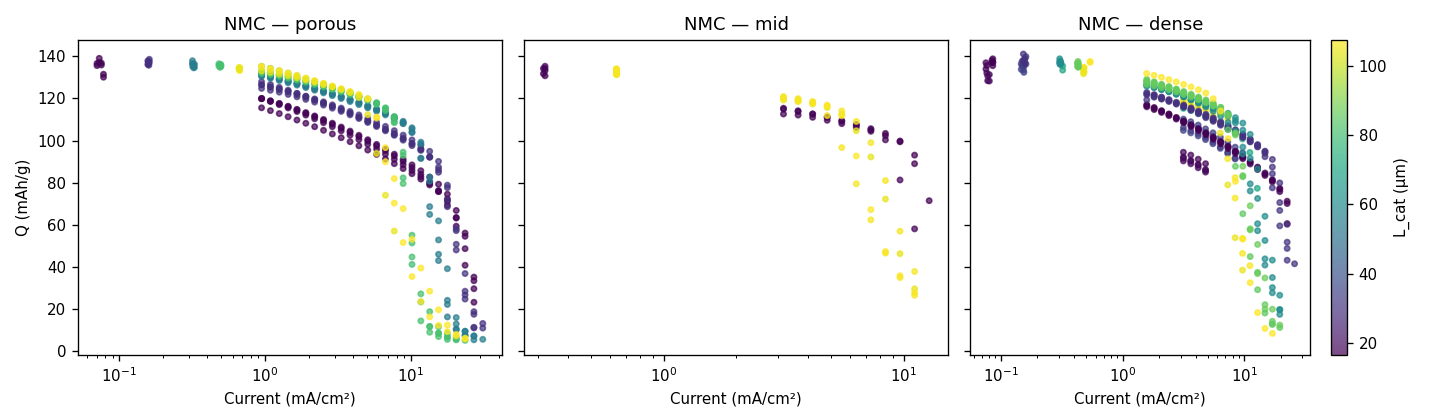
- Dataset: Brischetto et al. (J. Electrochem. Soc. 172, 040531, 2025) — 6,343 NMC622 and LFP discharges
- Outputs: exchange-current density (k₀), solid / electrolyte diffusivities (Dₛ, Dₑ), transference number (t₊), porosity fractions
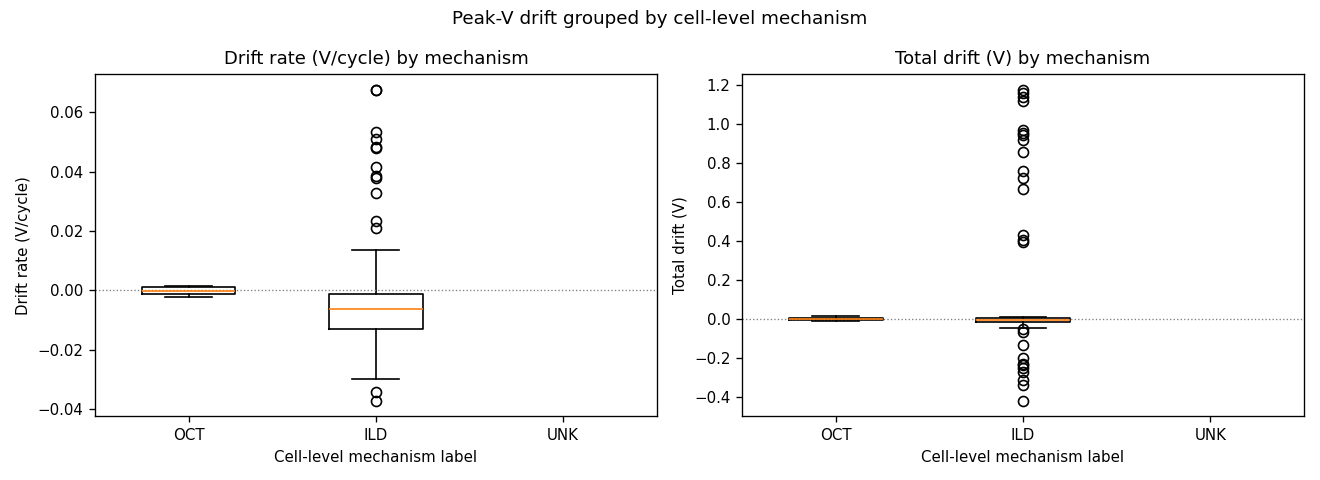
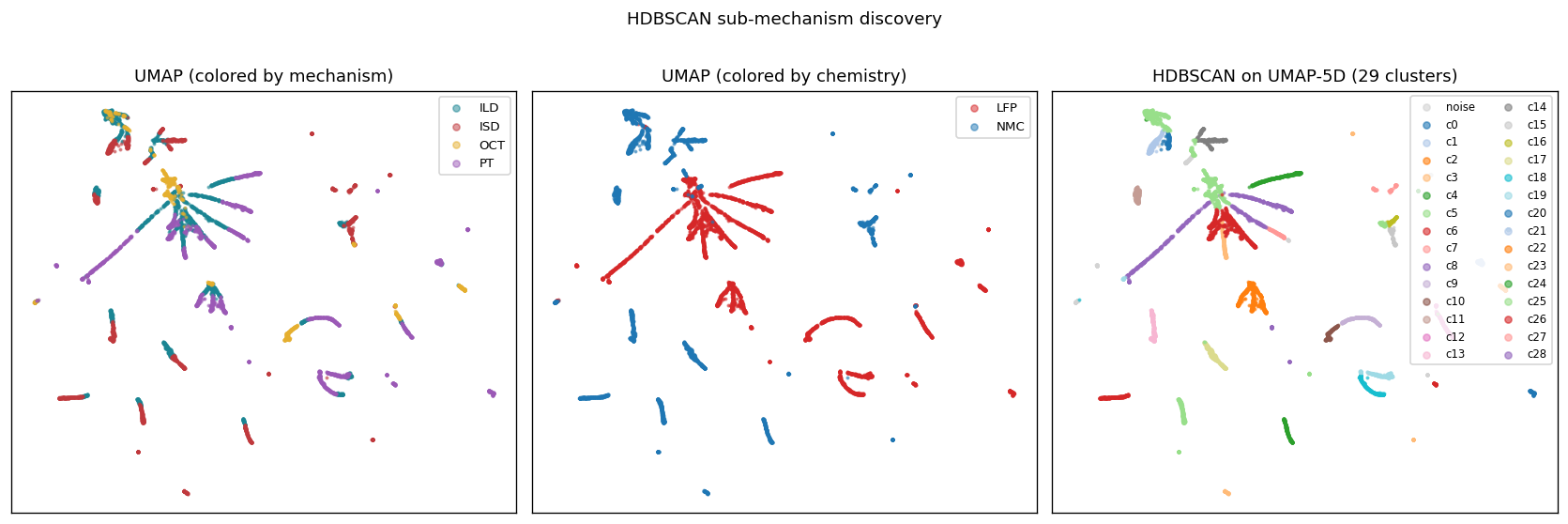
- Mechanism classifier: ISD, PT, OCT, ILD (interfacial / transport / ohmic / ionic-limited diffusion)
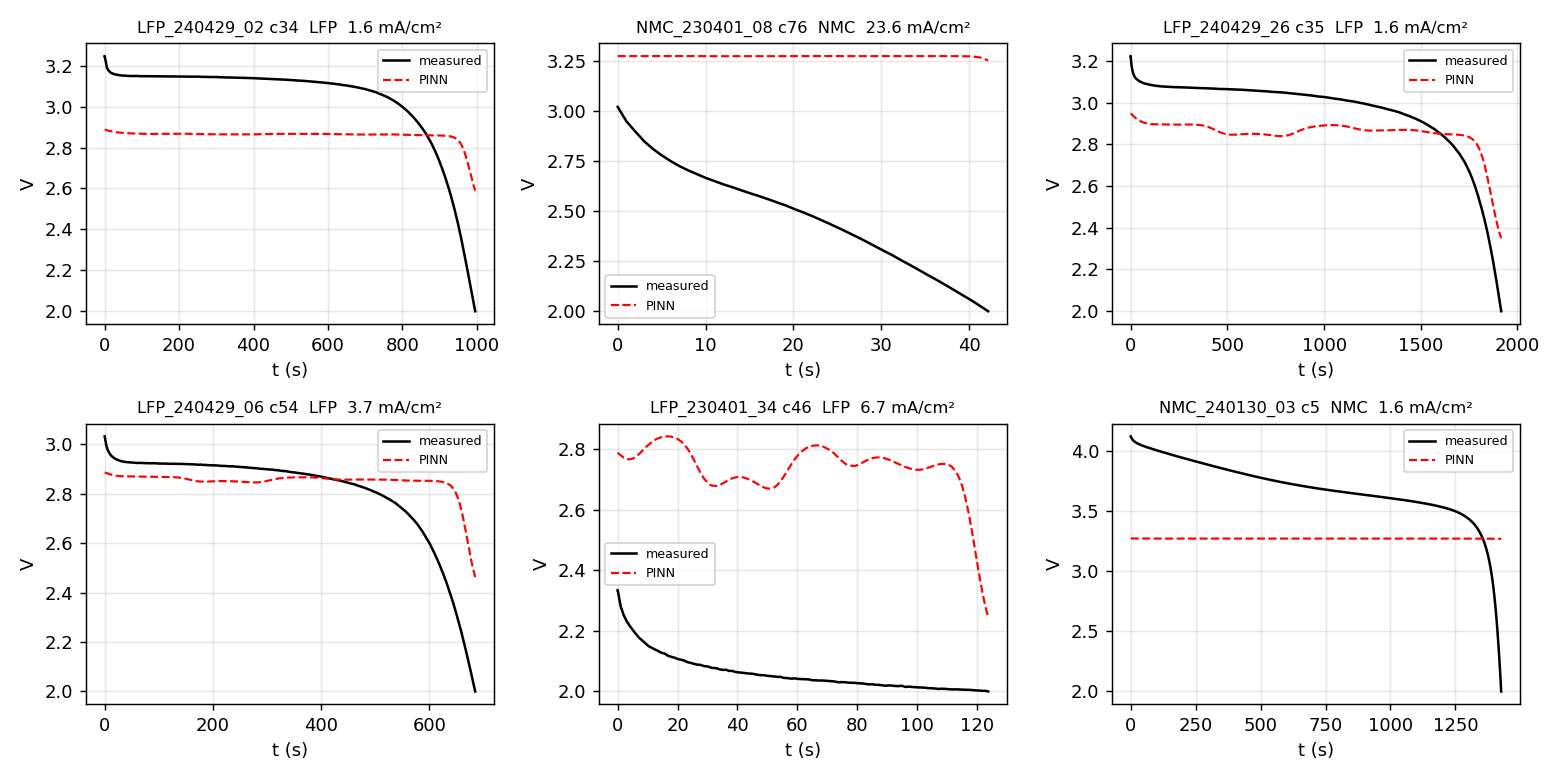
- Baseline: 27.7 mV median V-RMSE
02 Method
The network ingests a discharge trace and outputs a vector of electrode-resolved parameters, which are passed through a reduced-order P2D forward model and trained against the observed voltage with a residual loss. Two extra signals shape the latent space:
- dV/dQ mining: a parallel head learns to reproduce the differential capacity curve, which is sensitive to phase transitions and SEI growth
- Cycle-to-cycle regularization: parameters are constrained to drift slowly with cycle count, exposing degradation trajectories
- Cross-chemistry transfer: NMC↔LFP transfer learning shows where the latent representation is chemistry-shared vs chemistry-specific
03 Visuals
04 Why it matters
Battery R&D is bottlenecked on diagnosis — most cells fail in ways that can't be inferred from a single capacity-fade curve. A PINN that reads V(t) and tells you which mechanism is limiting which electrode at which cycle is the kind of tool that fits cleanly into Battery500-style high-throughput discovery loops, where the bottleneck is interpretation, not data.