01 Overview
Atom probe tomography (APT) produces 3D point clouds of individual atoms with sub-nanometer spatial resolution and chemical specificity. The catch: detecting chemical segregation (precipitates, clusters, GP zones, RIS at grain boundaries) traditionally requires manual ROI selection or assumed phase models. This project replaces that with a graph-based unsupervised method.
Two threads:
- Compositional Community Detection (CCD) — applies graph-theory community detection (Louvain / Leiden) to APT point clouds, where edges encode local compositional similarity. Communities correspond to compositionally distinct regions, with no prior phase model required.
- APTVIZ — a Python Flask GUI for interactive APT dataset upload, mass-bin inspection, and 3D rendering of the resulting communities.
02 Applications
The method has been validated on two systems:
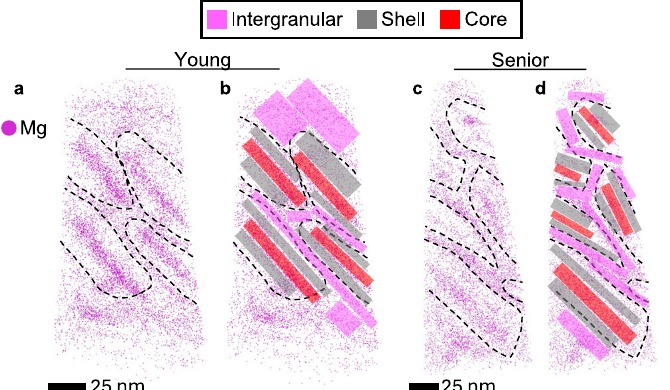
- Mature enamel aging APT — structural water and trace-organic heterogeneity in the mineral phase
- Irradiated stainless steel — radiation-induced segregation at grain boundaries, where conventional cluster-finding methods are sensitive to user-set parameters
03 Outcome
Published in Microscopy and Microanalysis (June 2025, ozaf036) with PNNL collaborator Arun Devaraj. APTVIZ is open-source and available for adoption by other APT groups; the CCD method is positioned as a drop-in replacement for parameter-sensitive cluster-finding workflows.